Surface Coatings: Be Pre-prepared

May 26, 2026

As part of our ongoing blasting and surface preparation series, this blog highlights the importance of correct pre-blast cleaning and inspection before protective coatings are applied to steel substrates. Proper surface preparation is essential for achieving long-term coating performance and reducing premature coating failure.

Why Surface Preparation Matters

It’s important that prior to blast cleaning, a surface should be thoroughly pre-prepared to remove contaminants that could negatively affect the final protective coating.
Whether you’re painting or adding any other type of finish to steel, it won’t offer the performance unless the surface is correctly prepared. In this way, you are helping to ensure that the final protective coating will adhere properly in accordance with the overall surface blasting and coating specification. Remember that when a coating (paint or powder) doesn’t adhere to the substrate, the coating will either not adhere properly and fail prematurely, requiring unnecessary rework and cost.

Starting the maintenance cycle with a properly prepared surface finish will improve the appearance and functionality of your components. Before any abrasive blast cleaning is conducted on a steel substrate, it is important that the surface is also fully inspected – this should be undertaken by a suitably qualified coating inspector or coating supervisor – to ensure that the steel is suitably pre-prepared and/or cleaned.

Common Surface Preparation Requirements

Surface preparation work can cover a multitude of things but any routine would typically include some or all of the following:

  • Grease/oil contamination – all grease and oil must be removed from the substrate before abrasive blast cleaning. If grease and oil are present during the abrasive blast cleaning, it will spread over the substrate.
  • Excess scale/heavy rust – excess scale and heavy rust must be removed prior to abrasive blast cleaning. This is generally done using the correct tools such as impact hammers and scrapers to ensure full compliance.
  • Skip welds (tack welds) – These welds should be filled, either before blast cleaning (welding) or after blast/priming with a suitable sealer.
  • Sharp edges – it’s important that sharp edges should be finished with rounded or curved edges (radiused – usually 2–3 mm) before abrasive blast cleaning.
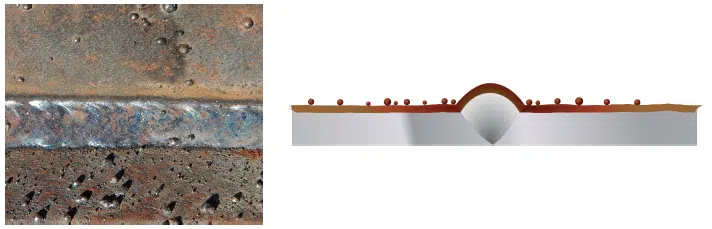
  • Weld spatter – the small droplets of molten metal that are generated during MIG or MMA welding at or near the welding arc, known as weld spatter, should be removed before/after blast cleaning.

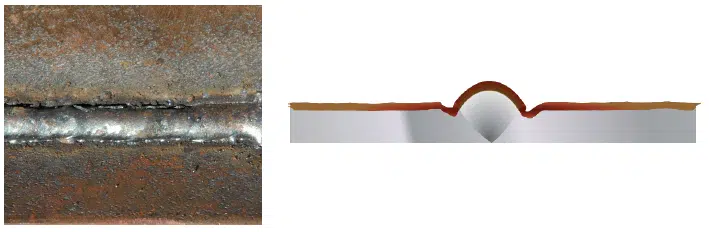
  • Undercutting (of weld) – any undercuts on a weld must be repaired by welding
    before blast cleaning is carried out

  • Porosity/blowholes – porosity/blowholes should be filled by welding (pre-blast) or
    a suitable filler after blast cleaning
  • Laminations/shelling – laminations or shelling are normally only identified after
    abrasive blast cleaning

Inspection Considerations

It’s important to note that while most of the above will be visible before the blast cleaning process, items such as porosity, laminations and blowholes may only be visible once the process is finished. Therefore, prior inspection of welding should be conducted and carried out by a qualified welding inspector, or the client.

This guidance, along with a wide range of additional technical resources, is available through the Corrodere app, designed to support inspectors, technicians, and coating professionals throughout their careers. The app also provides access to digital ID cards, renewal reminders, training resources, industry updates, and other tools to help professionals stay connected, compliant and informed within the industry.

More News

Corrodere Black Friday Protective Coatings Training Sale

Corrodere Black Friday Protective Coatings Training Sale

Our Black Friday offers are here, bringing you some fantastic opportunities to invest in professional development, strengthen workforce skills and expand your training opportunities! Whether you’re looking to progress your career, upskill your team or become a Train...

read more
Meet our ICorr Assessors: Stuart Fitchet

Meet our ICorr Assessors: Stuart Fitchet

Next up in our ICorr Assessor series is Stuart Fitchet, who brings over 50 years of coatings industry experience to Corrodere’s ICorr training and assessments. Here, we speak with Stuart to learn more about his background, his approach to training, and what he enjoys...

read more
Corrodere at Highways UK

Corrodere at Highways UK

Last week, Lucy and Ella attended Highways UK, connecting with industry professionals, strengthening relationships and exploring the latest developments across the highways and infrastructure sector. It was a fantastic opportunity to catch up with familiar faces,...

read more